Which drive system is the right one?
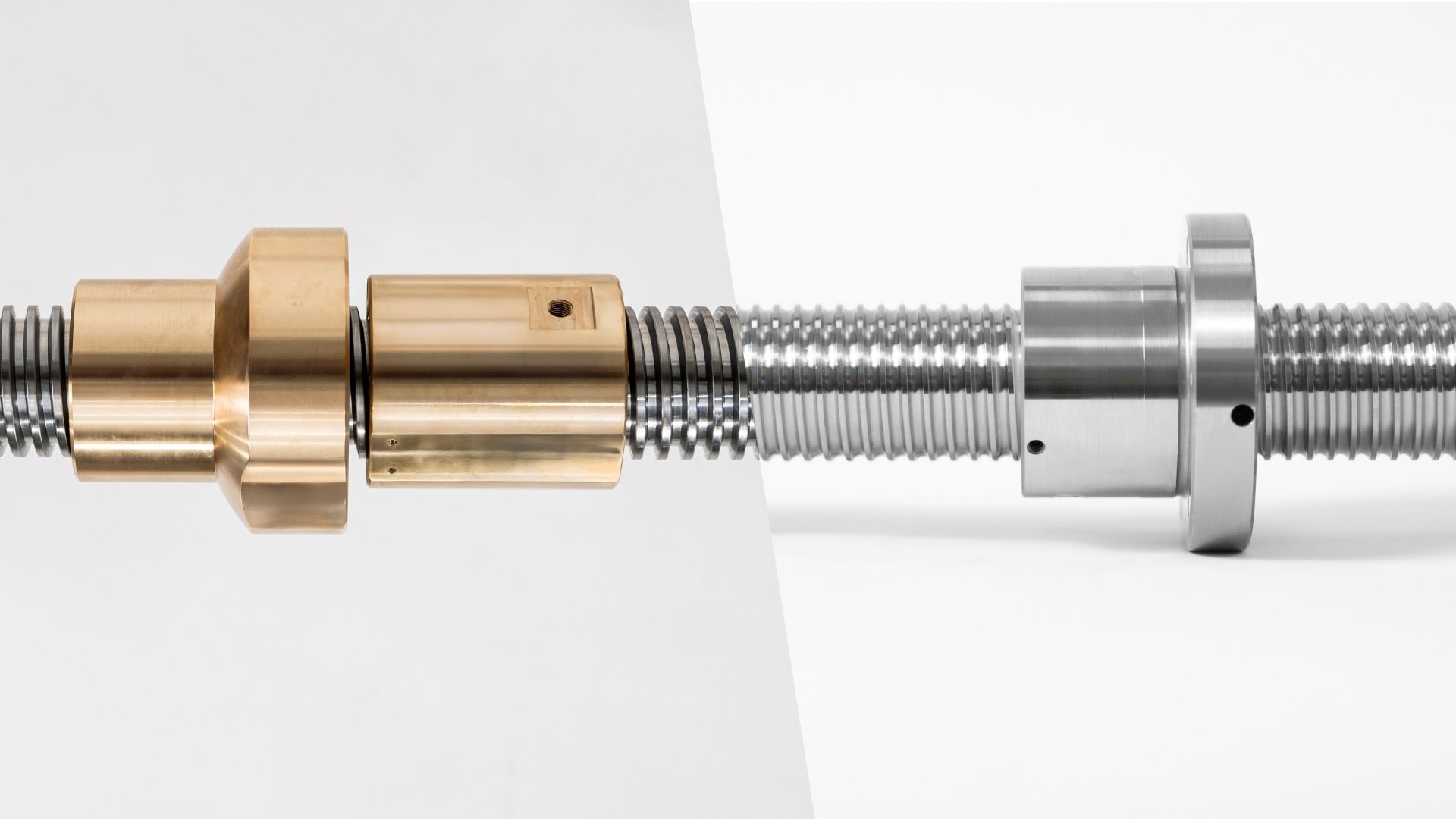
In the world of mechanical engineering, screw drives play a central role in converting rotary motion into linear motion. Two of the most important types are the ball screw and the trapezoidal screw. Both systems have their strengths and weaknesses: the choice depends largely on the specific application.
Basic principles
Ball screws:
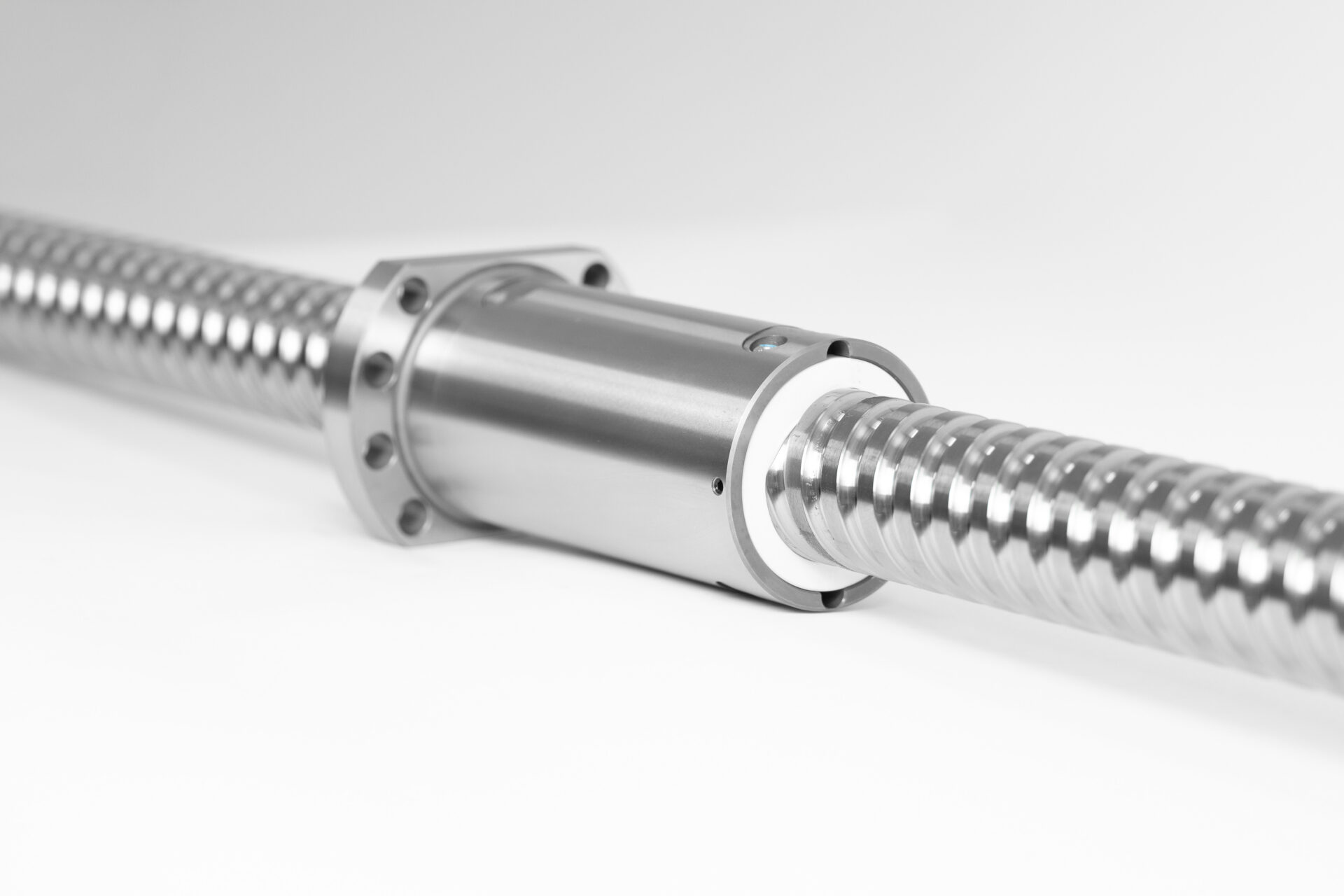
The ball screw uses balls as rolling elements between the spindle and the nut. This greatly reduces friction and significantly increases efficiency. The system is highly precise, but more expensive and less self-locking.
Trapezoidal screw drives:
In a trapezoidal screw drive, the force is transmitted directly through sliding contact between the screw and the nut. The thread profile is trapezoidal, which allows for high load capacity and good self-locking. However, due to the frictional contact, higher friction losses occur.
Comparison at a glance
| Feature | Trapezoidal Screw Drive | Ball Screw Drive |
|---|---|---|
| Efficiency | approx. 30 – 40 % | Up to 98 % |
| Axial Backlash | Can be several tenths of a mm (reducible with double nut) | Backlash avoidable through preload |
| Dynamics | Suitable for low to medium speeds | High travel speeds and accelerations possible |
| Load Capacity | Very good for static loads | High, uniform load distribution via balls |
| Self-locking | Yes, with small leads | No, external brakes required for vertical loads |
| Positioning Accuracy | Medium | Very high (micrometer range) |
| Service Life / Wear | Higher wear due to sliding friction | Very durable due to low-friction rolling motion |
| Noise Level | Higher, especially at high speeds | Quiet and smooth |
| Size / Compactness | Robust, simple design | More compact at equal precision, but more complex design |
| Cost | Low | Mid-range, offset by efficiency and durability |
| Application Areas | Lifting and machine applications, simple linear movements | Precision machines, automation, medical technology, CNC systems |
Detailed examination
1. Efficiency and energy efficiency
The ball screw drive achieves an efficiency of up to 95% thanks to the rolling motion of the balls. This means that less energy is lost as heat, making it ideal for dynamic applications such as CNC drives.
The trapezoidal thread drive, on the other hand, has lower efficiency due to its sliding friction, but is particularly well suited when self-locking is desired (e.g., lifting tables or clamping devices).
2. Self-restraint and safety
A key advantage of the trapezoidal thread drive is its self-locking capability: when the motor is switched off, the position remains stable—without the need for an additional brake. Ball screw drives, on the other hand, usually require a mechanical brake or a holding torque from the motor.
3. Wear and tear and maintenance
Since ball screw drives roll instead of slide, wear is lower and service life is longer. However, regular lubrication is required.
Trapezoidal screw drives are more robust against contamination and require less complex maintenance, but due to higher frictional wear, they have a shorter service life.
4. Precision and repeatability
For positioning tasks, such as in machine tools or 3D printers, the ball screw drive clearly has the advantage. It achieves high accuracy and minimal backlash.
In contrast, the trapezoidal screw drive is sufficient for simpler positioning tasks where high precision is not required.
Typical application examples
| Ball Screw Drives | Trapezoidal Screw Drives |
|---|---|
| CNC Milling Machines | Lifting Spindles in Lifting Platforms |
| Precision Measuring Instruments | Adjusting Screws in Machines |
| Robotics and Automation | Adjustment Units in Simple Automations |
| Linear Axes with High Speeds | Clamping Devices |
Conclusion: Which drive system is the right one?
The choice between trapezoidal and ball screw drives depends on the requirements:
Trapezoidal screw drives are ideal when robustness, self-locking and cost are paramount.
- Recommendation: For static or slowly moving systems
Ball screw drives are the better choice when high dynamics, precision and efficiency are required.
- Recommendation: For precise, fast-moving axes and CNC applications.