Precision under pressure
2-point and 4-point contact
If you want to achieve high positioning accuracy, zero backlash and smooth operation in your machines, preloaded ball screws are essential. The preload on the nut plays a crucial role, particularly in automation technology, robotics and CNC machining. But what types are available, and when is a 2-point or 4-point preload the best choice?
Why preload?
In a ball screw, the spindle and nut convert rotational motion into linear motion. Between them are balls that transmit forces. As with any rolling element, this results in a minimal amount of backlash.
This play may be undesirable in many precision applications, such as milling or positioning tool axes.
Preload eliminates this play by applying a controlled axial force between the spindle and the nut. This causes the balls and raceways to deform slightly elastically, so that there is no longer any play and the movement becomes smooth and precise.
2-point clamping: The classic choice for precision
In a two-point preload arrangement, the balls are loaded at two contact points, which are usually opposite each other. This is often achieved by combining two split nut halves, which are clamped together using spacer rings or spring washers.
Advantages:
- Good damping properties
- High rigidity and zero backlash
- Proven, cost-effective solution
- Ideal for linear axes with alternating load directions
Disadvantages
- Slightly higher assembly effort
- Slightly increased friction and heat build-up due to preload
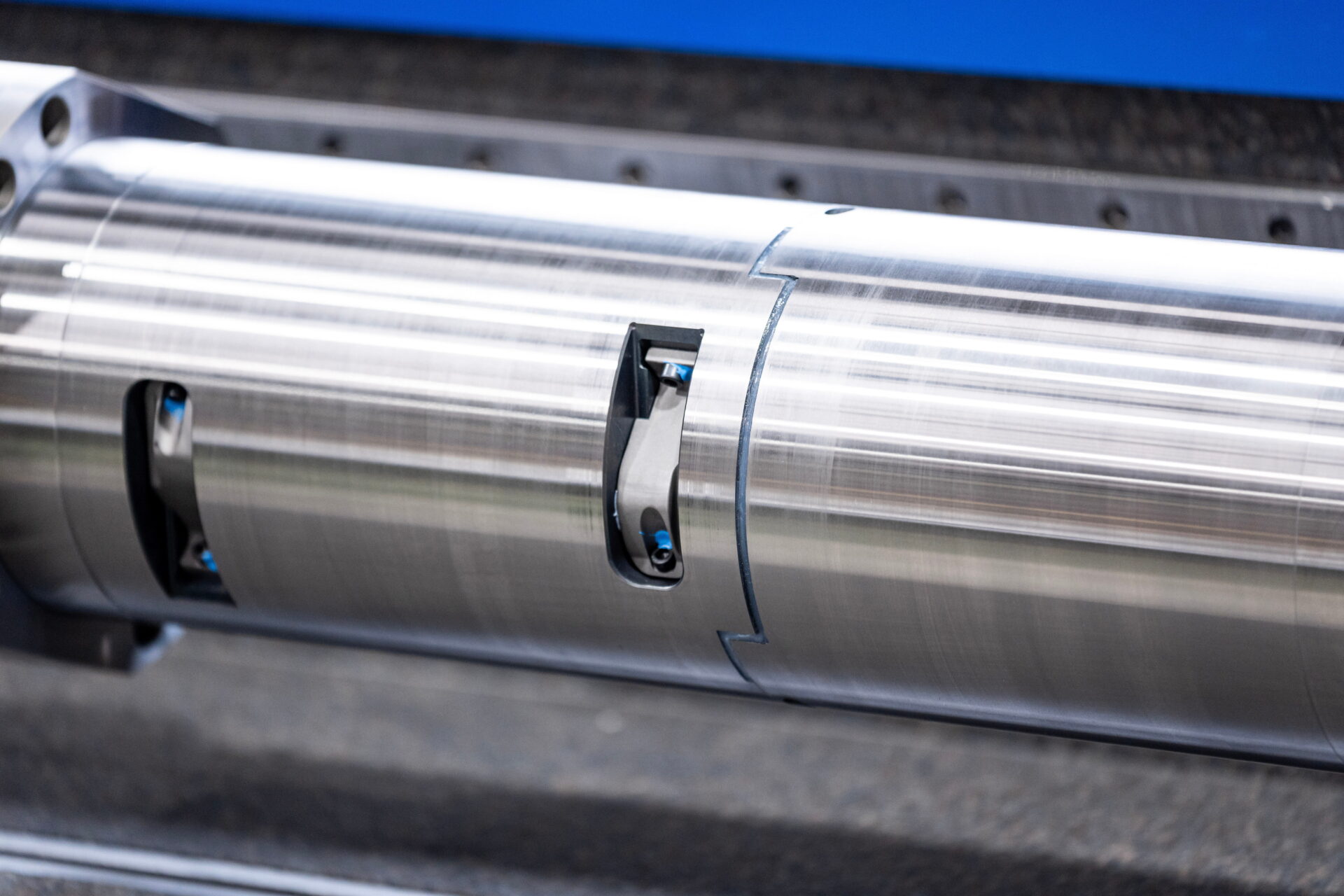
Double flange nut with 2-point contact
Typical applications
The 2-point preload is primarily used in CNC milling machines, positioning machines and conventional machine tools. These applications require high rigidity and maximum zero backlash, especially under alternating loads and demanding machining processes.
The double nut solution ensures stable, precise axis movement and supports consistently high manufacturing quality.
4-point preload: Zero backlash with a single nut
In the 4-point preload, a single nut takes over the preloading, as the balls are in contact with the spindle and nut at four points.
This is usually achieved using larger balls: the balls are elastically preloaded at four points, resulting in a backlash-free and compact solution.
Advantages
- No need for double nut designs, resulting in a more compact construction
- Less assembly effort
- Zero backlash in both directions of movement
- Fewer parts, lower weight
Disadvantages
- Slightly lower rigidity compared to double nut systems
- Limited adjustability of preload (in µ-steps)
Typical applications
The 4-point preload is particularly well suited to robotics, handling systems and compact precision axes. Wherever installation space is limited and at the same time dynamic, zero-backlash movements are required, the single-piece nut offers constructive advantages. The low weight and compact design support modern, high-performance machine concepts.
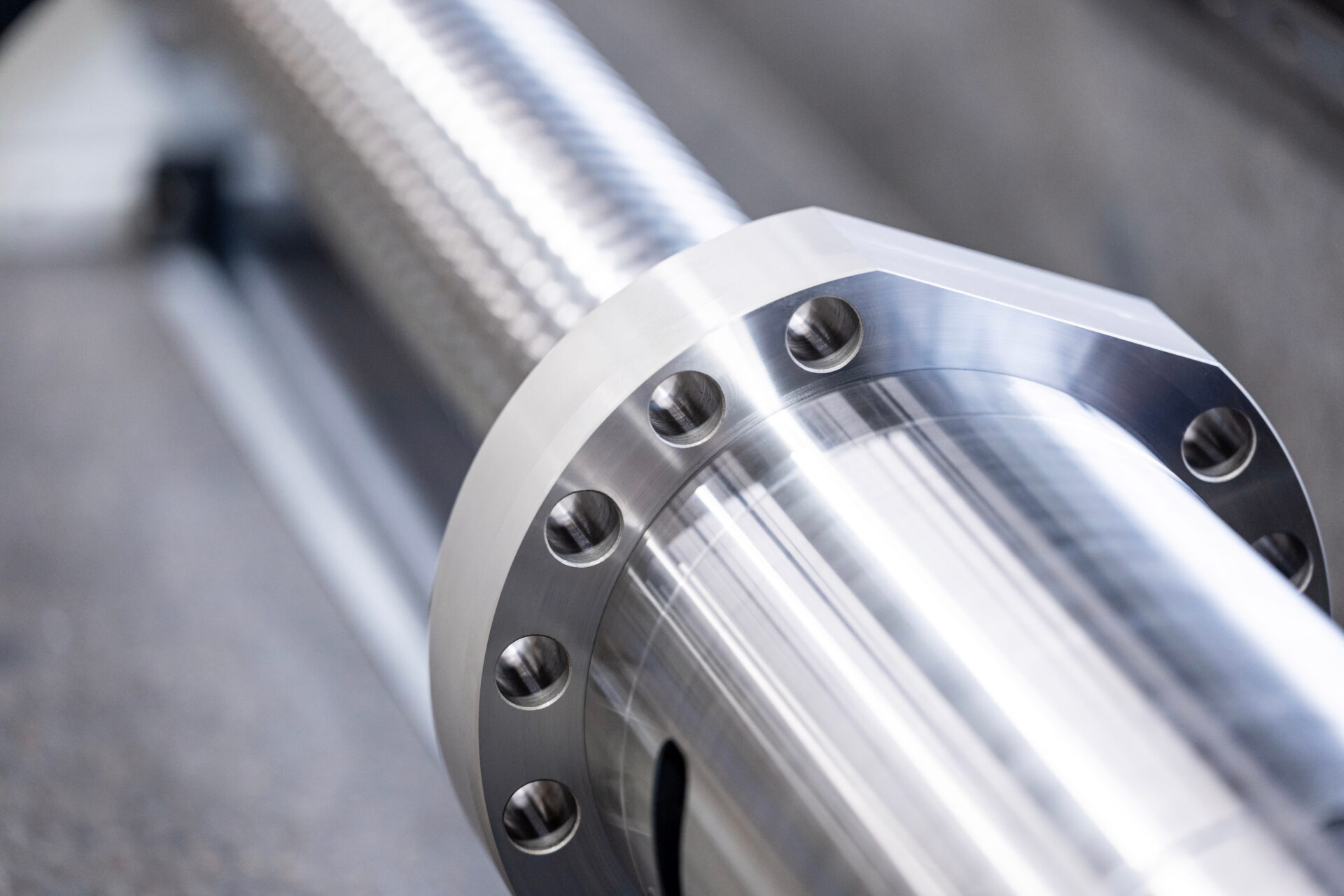
Single flange nut with 4-point contact
Comparison: 2-point vs. 4-point preload
| Feature | 2-Point Preload | 4-Point Preload |
|---|---|---|
| Design | Two preloaded nut halves tensioned against each other | One nut with special raceway |
| Contact Points per Ball | 2 | 4 |
| Size | Larger | More compact |
| Preload | Very high | High |
| Assembly Effort | Higher | Lower |
| Cost | Medium | Lower |
| Adjustable Preload | Yes | Limited |
| Application Area | Machine tools, axis drives, robotics, compact systemsRobotik, kompakte Systeme | Machine tools, axis drives, robotics, compact systemsRobotik, kompakte Systeme |
Conclusion: The right preload for every application
Both preload types have their merits – what matters are the requirements in terms of space, rigidity, precision and dynamics.
The 2-point preload is used when maximum rigidity and load capacity are the primary requirements, such as in machine tools and CNC axes.
The 4-point preload is used when compact designs and lower weight are required, such as in robot axes, pick-and-place systems or mobile devices.

Practical tip
Too much preload leads to unnecessary friction and heat build-up, while too little leads to backlash and inaccuracy.
Preload values should therefore always be adjusted to the load and operating conditions – ideally in close coordination with the ball screw manufacturer.